
The Lexington Subdivision
Between Ashland, Kentucky and Louisville by way of Lexington — compiled from archival records and the recollections of the people who worked, rode, and lived along the line.
Introduction
The Lexington Subdivision of the Chesapeake & Ohio Railway was, for most of a century, a modest but vital thread in the fabric of eastern and central Kentucky. Running some 124 miles from Ashland, on the Ohio River, west through the rugged Appalachian Plateau to Lexington, and beyond over trackage rights to Louisville, it never carried the tonnage or prestige of the C&O's James River or New River mainlines. Yet it carried the C&O's finest varnish — the George Washington and the F.F.V. — through some of the most scenic and least accessible country in Kentucky, and it linked the Bluegrass region's horse farms and bourbon warehouses to the coalfields, iron furnaces, and river trade of the Ohio Valley.
This history draws together material gathered by the Chesapeake & Ohio Historical Society over several decades — newsletter and magazine articles, timetables, track charts, and firsthand recollections of the conductors, brakemen, and travelers who knew the line. It follows the Lexington Subdivision from its improbable 1852 charter, through Collis P. Huntington's transcontinental ambitions, the golden age of steam passenger service, and finally to its slow decline and 1985 abandonment west of Coalton — leaving only a short stub of the once-through route in service today.
Before the C&O: The Lexington & Big Sandy
What became the Lexington Subdivision began, on paper, decades before a single C&O train reached it. On January 9, 1852, the Kentucky legislature chartered the Lexington & Big Sandy Railroad, with the right to build east from Lexington to a point on the Big Sandy River near Catlettsburg. The Panic of 1857 killed the scheme before track could be laid. (McChord 1976)
The idea was revived on January 29, 1869, when the Elizabethtown, Lexington & Big Sandy Railroad (EL&BS) was incorporated; on February 6, 1871, it acquired the rights of the defunct Lexington & Big Sandy. By 1872 the EL&BS had graded and laid roughly thirty-three miles of track east from Lexington to Mt. Sterling, and had built the stone piers for a bridge over the Big Sandy near Catlettsburg — piers that would stand bare of any superstructure for eight years. Another financial depression stopped the work cold. Because the finished stub connected in Lexington with the Lexington, Cincinnati & Louisville Railway, it was leased out for several years, allowing trains to run between Mt. Sterling and Louisville while the rest of the route to the Big Sandy sat unbuilt. (McChord 1976)
General I. M. St. John, the C&O's chief engineer, favored a route that would run up the Big Sandy River from the bridge site, then north along a tributary and over a divide to Denton, Kentucky. The masonry already placed for the bridge had been sited with this route in mind. But St. John died in 1880 before construction resumed, and Collis P. Huntington — who by then controlled the project — installed M. L. Lum as chief engineer with instructions to build cheaper. Lum abandoned St. John's plan for a long tunnel at Olive Hill in favor of a line with steep grades over Corey Hill, a decision examined further in Chapter 3. (McChord 1976)
A Ready-Made Connection
Rather than build west from the Big Sandy bridge himself, Huntington struck a deal with the Means brothers of Ashland, who already operated the Ashland Coal & Iron Railroad (AC&I) between Ashland and their coal mines at Coalton — a line with its own long history, told in full in Chapter 7. Huntington's C&O would build from Huntington, West Virginia to the Big Sandy bridge; the EL&BS would build downstream from the bridge through Catlettsburg to Ashland to connect with the AC&I, a considerable detour from St. John's original alignment that required a long, high trestle curving more than ninety degrees to reconcile the mismatch. In exchange, the Means brothers agreed to extend the AC&I ten miles beyond Coalton to Denton and grant the EL&BS twenty-five years of trackage rights between Denton and Ashland. The C&O eventually acquired the AC&I outright before the second lease term expired. (McChord 1976)
Track gangs finally closed the gap, and the first C&O train reached Lexington on December 12, 1881. The following year the company opened its first Lexington passenger depot, a subject taken up in Chapter 6. (McChord 1976)
Collis P. Huntington and the Coast-to-Coast Dream
Collis P. Huntington was born at Harwinton, Connecticut, on October 22, 1821, the son of a farmer and small manufacturer. His formal schooling ended at thirteen. By sixteen he was a traveling peddler; by his mid-twenties, a hardware merchant in Sacramento, California, in partnership with Mark Hopkins. The Huntington & Hopkins hardware store became a meeting place for a knot of ambitious Sacramento businessmen — Hopkins, Charles Crocker, and Leland Stanford — who, with engineer Theodore Judah's surveys in hand, incorporated the Central Pacific Railroad in 1861 to build the western half of the first transcontinental line. (Huddleston 1994)
Huntington served as the Central Pacific's financier and Washington lobbyist, raising capital, buying rail and rolling stock, and fighting a running battle with the rival Union Pacific over subsidies, land grants, and the point at which the two lines would meet. When the roads joined at Promontory in May 1869, Huntington did not attend the ceremony — the Central Pacific, in his eyes, was only half of the transcontinental he wanted. (Huddleston 1994)
An unrelated opportunity brought him east of the Mississippi. New York investment bankers, seeking help to finish the war-interrupted Chesapeake & Ohio as a trunk line between Chesapeake Bay and the Ohio River, recommended Huntington to the C&O's promoters. He inspected the mountainous unfinished route in person, raised most of the needed capital, and became C&O president in 1869. The line was completed to the Ohio River in 1873, at the new town Huntington named for himself — Huntington, West Virginia — where he sited the railroad's main locomotive shops. (Huddleston 1994)
From there Huntington kept building: eastward to Newport News on Chesapeake Bay (his second new city, founded 1882), westward to Cincinnati (1886–1889), and, through the Elizabethtown, Lexington & Big Sandy, on to Lexington in 1881. For a brief period in the mid-1880s his holding company, the Newport News & Mississippi Valley, tied together the C&O, the EL&BS, lines running from Louisville to New Orleans, and the Kentucky Central — nearly 1,900 miles under one management, broken only by the ninety-four-mile gap between Louisville and Lexington operated under a traffic arrangement with the Louisville & Nashville. It was, for a moment, very nearly Huntington's long-sought coast-to-coast railroad. Financial panics in 1873 and 1884, and the 1888 receivership of the western connecting lines, ended the dream — though the C&O itself emerged from the reorganization intact. (McChord 1976; Huddleston 1994)
Huntington's Letters: Building the Line by Mail
Huntington ran the EL&BS construction from his New York office almost entirely by correspondence, and a surviving run of his letters from late 1880 through 1881 — addressed to chief engineer M. L. Lum, contractor C. R. Mason, and General John Echols — gives an unusually close view of how the line was actually built. Huntington pressed constantly for speed and economy. Of the depot at Morehead he wrote that Lum could use his own judgment, but that the price quoted “is more than I supposed the building would cost.” Of the new Lexington passenger depot, after being told the plans were too plain, he allowed a slightly more ornamental building but capped the cost firmly: “in no case must the cost exceed $5,000.” (Huddleston 1994)
Much of the correspondence concerns two stubborn tunnels: the Triplett, near Soldier, Kentucky, and the Means (later called Williams Creek) tunnel, just east of Denton. Progress on both was “moving fearfully slow,” Huntington complained in December 1880, and he pushed contractors and engineers alike through the winter of 1880–81 to finish them. Triplett Tunnel was completed around October 1, 1881; the Means tunnel opened in late November 1881 — just in time for the arrival of C&O's first train at Lexington that December. (Huddleston 1994)
Huntington's economy showed everywhere in the finished line, and not always for the better. “The line from Lexington to Ashland probably never should have been built,” one C&O historian later judged. “Because it was built, it should have been to higher standards.” Triplett Tunnel itself was abandoned in 1934–35 in favor of an open cut once its soft shale roof proved chronically unstable — vindicating, a half-century late, the concerns of the engineers Huntington had overruled. (Huddleston 1994)
Building the Line: Tunnels, Grades, and Hard Bargains
For a line only 124 miles long, the Lexington Subdivision was unusually difficult to operate. Its route crossed five separate watersheds between Ashland and the Bluegrass Plateau near Mt. Sterling — a consequence, later writers noted, of a railroad running east-west through country whose natural drainage ran south to north. Every ridge between one stream valley and the next meant another grade to climb and another to descend, with no long stretches of easy running in either direction. (McChord 1976)
The most notorious of these was Corey Hill, the divide between the Tygarts Creek and Little Sandy River drainages, between Olive Hill and Aden. It carried a mile of 2.67 percent grade westbound and three-quarters of a mile of 2.65 percent eastbound, with long approach grades on both sides and no opportunity to run at the hill for momentum. Helper locomotives — commonly a 2-6-6-2, sometimes relieved at “monthlies” by a K-2 or K-3 Mikado — assisted freight trains up the hill from either Olive Hill or Aden, cutting off on the fly at the summit. Passenger trains were usually not assisted, since coupling a helper ahead of a stopped passenger train (federal rules forbade coupling it behind the coaches) cost time the schedule could not spare. Chapters 9 through 11 return to Corey Hill's influence on locomotive assignments and helper crews. (Huddleston 1998)
The line's engineering compromises showed up again and again in operating restrictions. Weight and clearance limits west of Lexington, where C&O used Louisville & Nashville track under a trackage-rights agreement, kept the heaviest steam power off the Louisville run for decades; an 85-foot turntable at the shared engine terminal in Louisville — inherited from the old “Big Four” (Cleveland, Cincinnati, Chicago & St. Louis) route — could not turn the longest Mountain-type locomotives, which had to use a nearby wye instead. (Huddleston 1998)
The Route: Ashland to Lexington to Louisville
The Lexington Subdivision proper ran from Ashland, on the Ohio River, west through Boyd, Carter, Rowan, Bath, Montgomery, Clark, and Fayette counties to Lexington — a distance the C&O reckoned at 124 route miles, with mileposts measured, per C&O practice from 1930 onward, from Fort Monroe, Virginia. West of Lexington, C&O passenger and freight trains continued into Louisville under trackage rights over the Louisville & Nashville — a relationship the railroad dated to 1895, though as the section below describes, the arrangement actually reached back further than that, and its mileage changed partway through. (McChord 1976)
Leaving Ashland, the line climbed away from the Ohio River through Winslow and Summit, past the old Ashland Coal & Iron trackage at Coalton, Kilgore, and Rush, and on to Denton and Mt. Savage. At Hitchins — also known as Eastern Kentucky Junction — the Eastern Kentucky Railway, a connecting shortline known locally as the “E.K.,” joined the C&O. From there the route ran through Leon, Grahn, and Mountain Top, climbed Corey Hill west of Olive Hill, and continued through Enterprise to Soldier, near the site of the old Triplett Tunnel, and Haldeman. (McChord 1976; Huddleston, Sept. 1976)
Morehead, the largest town on the line's midsection and home to Morehead State University, followed, with Farmer, Salt Lick, Olympia, Preston, and Stepstone strung out along the way toward Mt. Sterling — the point at which the line finally reached the level ground of the Bluegrass Plateau after its long fight through the Appalachian Plateau's ridges and hollows. From Mt. Sterling the route continued through Ewington, Thomson, and Hedges to Winchester, then through Pine Grove and Chilesburg into Lexington itself. (McChord 1976)
At Lexington the C&O connected with several other lines: the Louisville & Nashville, the Cincinnati, New Orleans & Texas Pacific (running north-south through Lexington to Chattanooga), the Southern Railway, and, to the west, the old Louisville, Cincinnati & Lexington route — itself a lineal descendant of the Lexington & Ohio Railroad of 1830, said to be the first railroad west of the Alleghenies. That line originally used iron strap rail laid on limestone sills and horse-drawn double-deck coaches; in 1848 a 500-foot tunnel was bored at Frankfort so trains could reach the city center directly, a tunnel still in use today. In 1896 an 8.51-mile cutoff between Christiansburg and Shelbyville shortened the Lexington-Louisville route by ten miles and became the path of virtually all C&O and L&N traffic thereafter. (McChord 1976; Bogart, Harnett 2005)
The Old Road: How the Trackage Rights Worked
The route the C&O used west of Lexington long predated the C&O itself. It began as the Lexington & Ohio Railroad of 1830, mentioned above, and reached its lasting shape as the Louisville & Frankfort Railroad, completed in 1851. The Louisville & Nashville bought the whole line — by then reorganized as the Louisville, Cincinnati & Lexington Railway — in July 1881, folding it into its Eastern Kentucky Division under the name railroad men already used for it: the “Old Road.” (Lexington History Museum, “Old Road”)
The C&O never owned a foot of that track; it got the use of it through leverage rather than purchase. In December 1881, only months after the L&N had bought the Old Road outright, the L&N granted trackage rights over it to Collis P. Huntington's Newport News & Mississippi Valley Railroad — the holding company behind the still-unfinished Elizabethtown, Lexington & Big Sandy, described in Chapter 1 — because Huntington was threatening to build his own competing line into Louisville rather than share the L&N's. Faced with that prospect, the L&N judged a shared track the better bargain. (Lexington Daily Transcript, Dec. 5, 1881, cited in Lexington History Museum, “Old Road”)
No source in hand explains the fourteen years between that 1881 grant and 1895, the date this history has long cited for the arrangement's formalization. The likeliest occasion is the 1892 consolidation that folded the EL&BS into the C&O outright: a trackage-rights grant made to Huntington's holding company would have needed renewing in the new C&O's own name, and 1895 may simply mark when that paperwork caught up with the 1892 merger. Whatever the reason for the gap, by the time of the Interstate Commerce Commission's formal valuation of C&O property, the contract terms stood at $60,000 a year, payable monthly, plus half of six percent annual interest on the cost of any improvements and a share of taxes, with maintenance and operating costs on the shared track divided by the number of cars each railroad actually ran over it — for 84.40 miles of main track between Lexington and Louisville, plus separate small payments for yard and depot trackage in both cities. (McChord 1976; ICC Valuation Reports, Vol. 24)
That 84.40-mile figure is not a contradiction of the ninety-four miles cited earlier in this chapter — it is the same trackage rights at a different point in their history. Subtract the ten miles the 1896 Christiansburg–Shelbyville cutoff saved from the post-cutoff distance and the pre-cutoff route comes out to almost exactly ninety-four miles: both figures are correct, one for the C&O's first fifteen years into Louisville, the other for virtually the whole of its twentieth-century operation there. (McChord 1976; ICC Valuation Reports, Vol. 24)
The Old Road outlived the C&O's own use of it. CSX, the C&O's eventual corporate successor, sold the line to the short line R.J. Corman Railroad Group in 2003; it still operates today under the same name railroaders were using for it in 1881. (American-Rails, “Kentucky Railroads”)
Running the Railroad: Timetables, Sidings, and Signals
Employee timetables and track charts, preserved in runs stretching from the 1930s into the 1960s, show a side of the Lexington Subdivision the passenger-train nostalgia tends to skip over: the day-to-day mechanics of running trains on a single-track line, and how those mechanics changed as traffic declined.
A Wartime-Era Schedule
Employee Timetable No. 133, effective May 6, 1945, and its near-identical successor No. 134, effective September 28, 1947, show the Lexington Subdivision at something close to its operational peak. Three westward passenger schedules — Trains 21 and 23 running daily, and Train 31 (later 25) running Mondays, Wednesdays, and Fridays only — shared the single track with three westward freight schedules, Trains 93, 95, and 73, classified third, fourth, and fifth class respectively. Eastward counterparts ran on the same pattern. Nearly every station of any size kept an agent: Rush, Hitchins, Grahn, Olive Hill, Enterprise, Haldeman, Morehead, Farmer, Salt Lick, Preston, Mt. Sterling, and Winchester all show specific office hours in the 1947 timetable, most running a six-to-eight-hour day and several, like Ashland, Olive Hill, and Morehead, keeping continuous coverage. (1947 Ashland Division Employee Timetable No. 134)
Beyond the scheduled stations, the timetable lists dozens of flag stops served only on signal — Gulfco, Winslow, Princess, Bailey Mine, Kilgore, Denton, Hayward (serving the Ashland Fire Brick Company plant described in Chapter 8), Corey (the operating point below Corey Hill), Rodburn, Midland, Klondyke, Thomson, Hedges, Fox, and Nelson among them — a reminder that the line's 33-station public timetable represented only part of the points where a train might actually stop. (1947 Ashland Division Employee Timetable No. 134)
Sidings, Spring Switches, and the Mountain Top Helper
The 1947 timetable's special instructions fill in details no passenger schedule would show. Passing sidings serving the Lexington Subdivision were located at Meads, Rush, Aden, Olive Hill, Soldier, Morehead, Preston, Mt. Sterling, Pine Grove, and the east switch at Winchester, with automatic block signal rules governing meets and passes between Ashland Junction and Lexington's Union Station. Interlocking plants controlled movements at A.X. Cabin (Ashland Junction) and at Winchester, where all electrically locked switches within interlocking limits required the operator's authority to use. (1947 Ashland Division Employee Timetable No. 134)
One instruction speaks directly to the operation described in Chapter 3: after a stalled train called for assistance at Mountain Top, on the west slope of Corey Hill, the waiting helper engine was authorized to leave its siding unassisted — the crew simply opened the siding switch, pushed a button mounted in a box on the switch post to call up a favorable signal, and proceeded to help. It was a small, practical rule, but it captures how routine the business of shoving trains over Corey Hill had become by the 1940s. Haldeman's electrically locked spur switch, noted as serving a “Brick Plant,” confirms the direct rail connection into the Kentucky Fire Brick Company works described in Chapter 8. (1947 Ashland Division Employee Timetable No. 134)
Locomotive assignments came with their own restrictions written directly into the timetable. Class K-4 Kanawhas — by the late 1940s the mainstay of Lexington Subdivision freight and, as Chapter 9 describes, eventually passenger service as well — were barred from Lexington's Union Station tracks 1 and 2 and from the Lexington Belt Line, and were not permitted to pass or be passed by other engines on the curve just east of Limestone Street. Such restrictions, ordinary as they read on the page, are a reminder of how tightly a line built to Huntington's economical standards, described in Chapter 2, continued to constrain equipment choices six decades after it opened. (1947 Ashland Division Employee Timetable No. 134)
A Shrinking Railroad: 1958 and 1966
The Ashland Division employee timetable effective in 1958 still shows a recognizable version of the 1947 railroad — the same station roster from Ashland to Netherland Yard, passing sidings identified by their car capacity (Rush at 92 cars, Grahn's siding unlisted, Olive Hill at 93, Mt. Sterling at 77), and agents still posted at the larger stations, though several had shortened hours: Mt. Sterling's agent, for instance, worked only 5:45 a.m. to 1:45 p.m. by 1958, a single early shift rather than the fuller coverage of a decade before. (1958 Ashland Division Employee Timetable)
By the time Timetable No. 153 took effect on April 24, 1966, the contraction was unmistakable. Only a single passenger schedule remained in each direction — Trains 21 and 22, the last vestige of the George Washington's Kentucky sections, gone entirely within five years — and the timetable's operating rule for the subdivision had been simplified to a single line: “On single track unless otherwise provided eastward trains are superior to westward trains of the same class.” Where the 1947 timetable had run three passenger and three freight schedules over an elaborate structure of automatic block signals, interlocking plants, and spring switches, the 1966 timetable governed what was, in effect, a single daily round trip and whatever freight extras the dispatcher chose to run — the same track, the same stations, but a fraction of the railroad that had once passed over them. (1966 Ashland Division Employee Timetable No. 153)
One of the last operating changes on record for the Lexington Subdivision concerned not new signals but new dispatching arrangements. A C&O Historical Society newsletter item reports that “Console C,” a dispatching desk at Russell scheduled to enter service on or about February 5, 1985, was to assume jurisdiction over Centralized Traffic Control between Aden and Olive Hill — Corey Hill itself, described in Chapter 3 — along with automatic permissive block territory covering the rest of the line from Ashland to Aden and from Olive Hill to the end of track. The same item notes that this territory had previously been “now controlled by the Kanawha Subdivision dispatcher,” which makes clear that CTC was already in place over Corey Hill by this point; what changed in early 1985 was which dispatcher's console held the board, not whether the hill was signaled. No source in hand establishes when CTC was originally installed there. Whatever the answer, the reassignment came five months after Chessie had already filed, in September 1984, to abandon the very ground that console was being set up to control, as Chapter 15 describes, and only about six weeks before the ICC approved that abandonment. (C&O Historical Society Newsletter, dispatcher console item, ca. 1984–85)
Depots and Division Points
Station architecture along the Lexington Subdivision reflected the line's patchwork history. Some of the smaller depots dated to the original Elizabethtown, Lexington & Big Sandy construction of the early 1880s and did not match later C&O standard designs at all. Depots built to C&O's 1920 standard were plain rectangular structures with little roof overhang and board-and-batten siding, while a distinctive group built in the first decade of the twentieth century — mostly in Kentucky and Virginia — used steeply pitched hipped roofs, often with a cross gable or large dormer, and were built of brick or frame rather than the later standard. (Mt. Sterling Depot 2002)
The depot at Farmer, Kentucky was an oddity even among these variations: built of rough-faced Kentucky Blue Stone ashlar, a material C&O otherwise reserved for bridge abutments and piers, at a time when most of the railroad's depots — even the substantial ones — were wood or brick. (Farmer Depot)
Mt. Sterling's depot, sited at milepost 90 measured west from Ashland Junction, served as the connecting point for freight and passenger business bound to and from Louisville. Decades after the line's abandonment, the depot was restored beginning in the mid-2000s through a student-led preservation project at the local Area Technology Center, which raised roughly $200,000 for the work. (Mt. Sterling Depot 2002, 2008)
Lexington itself saw a succession of stations. The 1882 depot at South Limestone and Water Streets, behind the Phoenix Hotel, gave way to Union Station, jointly built by the C&O, the L&N, and the Lexington & Eastern after the three roads approved the project in 1901; construction began in December 1905, and the $375,000 building opened on August 4, 1907, handling as many as twenty-six passenger trains a day in its best years. The C&O used Union Station until May 9, 1957, when the eastbound George Washington made the last departure from the building — by then the railroad had only two trains a day left to run, and the station had become far too large for the traffic it handled. The Cleveland Wrecking Company tore the building down in March 1960; a Stewart Dry Goods garage eventually rose on the site. Passenger business, meanwhile, moved into a waiting room built inside the freight station at Water and Rose Streets, used until 1968, when Lexington's urban renewal plan forced removal of the passenger tracks running through downtown. A new depot opened on Delaware Avenue on December 17, 1968, and lasted only until May 1, 1971, when Amtrak's creation ended C&O's Trains 21 and 22 for good. (McChord 1976; Brown 1988; Lexington History Museum, “Union Station”; Kentucky Photo Archive 2017)
In Louisville, C&O passenger trains traditionally used Central Station at Seventh Street and the Ohio River, built in the 1880s for Huntington's Chesapeake, Ohio & Southwestern and later shared with the Illinois Central, Baltimore & Ohio, and New York Central. The building had a rough history even before the C&O's tenancy there: the original wooden depot, then called Union Depot, blew away in a cyclone in 1890 and was rebuilt in brick that same year, only to burn in 1908 — no lives were lost, thanks to a telephone switchboard operator who stayed at her post to warn everyone out. The railroads ran their Louisville business out of a tent until the replacement building opened in 1909, renamed Central Station to avoid confusion with the L&N's separate Union Station across town. C&O used Central Station until May 31, 1963, when the eastbound George Washington made its final departure from the riverfront building; the next day the westbound George became the first C&O train to use L&N's Union Station instead. The vacated building stood until 1972, when it was demolished to make way for Interstate 64. (McChord 1976; “Central Station (Louisville, Kentucky),” Wikipedia; Kentucky Rail Task Force History)
Winchester's Union Depot
Winchester's own depot, a Georgian Revival building erected in 1906 to replace an earlier structure the mayor had once denounced as “a mortification to every citizen in town,” was shared by the C&O and the L&N and became, in its half-century of service, an unlikely stage for presidential politics. William Howard Taft spoke from a platform built specially for the occasion during his 1908 campaign; Theodore Roosevelt addressed a crowd of 2,000 at the depot in 1912; Woodrow Wilson's train stopped for five minutes in 1916 while he shook hands with two or three hundred well-wishers; and in 1940 some 200 people gathered hoping to see Franklin Roosevelt, who slept through the stop as his train was shunted from the L&N to the C&O line. Harry Truman added his own chapter to that history with a whistle-stop at the Winchester depot during his come-from-behind 1948 campaign — one more presidential visit to a station that, by then, had already outlasted several of the men who spoke from its platform. The depot itself did not survive much longer than the railroad it served: an L&N crew demolished it without public notice on the morning of July 25, 1981, prompting a mock funeral procession up Main Street the following week. (Winchester Sun 2022)
Truman's 1948 tour did not stop at Winchester alone. Photographs document a confirmed whistle-stop at Mt. Sterling on October 1, 1948, as part of a campaign swing that, by one account, crossed the United States coast-to-coast four times that year against challenger Thomas Dewey. Surviving photographs show the President, First Lady Bess Truman, and daughter Margaret on the train's rear platform at the Mt. Sterling depot, a crowd gathered to meet them, and the pair of K-4 Kanawhas — No. 2787 and a sister engine — that powered the special into town. A separate photograph and audio recording place Truman at Olive Hill as well, and the President's published itinerary settles the matter: the special worked the whole subdivision that day, west to east, with rear-platform stops at Lexington at 10:35 a.m., Winchester at 11:20, Mt. Sterling at 11:50, Morehead at 12:45 p.m., Olive Hill at 1:21, and Ashland at 3:54 — six of the day's eleven stops, and every one an agency station. Signal Corps recordings and full transcripts of all six survive. (C&O Historical Society Photo Collection, cohs-21288 through cohs-21299; C&O Historical Society photo and audio collection, “Truman's Remarks at Olive Hill”; Truman Public Papers 1948; Truman Sound Recordings 1948)
The Ashland Coal & Iron: A Railroad Before the Railroad
The first twenty-one miles of the Lexington Subdivision out of Ashland were, in fact, older than the C&O connection that made them famous. That stretch began life as the Lexington & Big Sandy Railway — an unrelated enterprise from a different 1852 charter than the one discussed in Chapter 1 — which by 1859 had built a line from Ashland to the iron country around Mt. Savage. Work on the line's signature engineering feature, Williams Creek Tunnel, began in 1853; rails were laid out of Ashland beginning in late 1855; and the first loads passed through the finished bore on November 7, 1857, with construction essentially complete by 1859 according to Poor's Manual of Railroads. (Huddleston, Sept. 1976)
On October 1, 1880, the railroad took the name by which history remembers it: the Ashland Coal & Iron Railway, so called for the coal mines at Coalton and the iron furnaces around Mt. Savage that were its reason for existing. By 1882 the AC&I owned two locomotives, two passenger cars, five freight cars, and 122 coal cars — a modest roster for a railroad that nonetheless controlled the only practical route into some of Carter County's richest mineral country. The Means brothers of Ashland, who ran the AC&I, used it to move iron from the furnace at Mt. Savage — among the very first loads through Williams Creek Tunnel — down to the Ohio River at Ashland, where it continued by barge. (Huddleston, Sept. 1976)
It was this established, working railroad that Collis P. Huntington found waiting for him when he began pushing the Elizabethtown, Lexington & Big Sandy westward from the Big Sandy bridge, as described in Chapter 1. Rather than duplicate the AC&I's line, Huntington struck his 1881 trackage-rights arrangement with the Means brothers, and the two roads met end to end at Straight Creek Junction (also called Denton or Seaton), twenty-two miles from Ashland. The C&O finally absorbed the AC&I outright in 1933, and the old road became, simply, the first segment of the Lexington Subdivision — the only segment, as it would happen, still in freight service today. (Huddleston, Sept. 1976; McChord 1976)
Three tunnels marked the old AC&I in its working days: Ashland Tunnel, a mile out of the depot; Princess Tunnel, nine miles out; and Williams Creek Tunnel, the original 1850s bore, eighteen miles out near Denton. A number of the line's old station signs — Gulfco, Summit, Meads, Princess, Bailey Mine, Rush, and Grant among them — were still standing more than a century later, along with a filled-in sixty-foot turntable pit at the old Denton terminal, removed around the time of the Depression. Deserted by the mid-twentieth century, Mt. Savage itself had been a boom town in the 1860s, '70s, and '80s, its furnace the AC&I's original reason for being. (Huddleston, Sept. 1976)
The AC&I's motive power told its own modest story. A Baldwin 2-6-2 numbered 14, built in 1912, apparently never carried a C&O number at all. A Baldwin 2-8-0, AC&I No. 17, came onto the C&O roster when the railroad leased the AC&I in 1925; reclassed G-15 and renumbered 1085, she worked the Big Sandy Subdivision until her retirement in 1951. And a curious compressed-air “fireless” locomotive built by Baldwin in 1896 for the AC&I — not a true fireless cooker, since it ran on compressed air rather than stored steam — hinted at industrial uses, likely around the Mt. Savage furnace, that have otherwise gone unrecorded. (Huddleston, Sept. 1976; McChord 1976)
Industries Along the Line
Passenger trains gave the Lexington Subdivision its glamour, but freight paid its bills, and the line's freight was as varied as the country it crossed — coal and iron in its first years, fire clay and brick for most of the twentieth century, timber, steel, and finally, briefly, the nation's trash.
Coal, Iron, and the Star Furnace
The earliest freight on the line, described in Chapter 7, was coal from the mines at Coalton and iron from the furnace at Mt. Savage, moving out over the old Ashland Coal & Iron Railway to the Ohio River at Ashland. A branch shown on early company maps ran from Kilgore to a place called Star Furnace, a little more than a mile northwest of Rush — one of several small iron operations that gave the AC&I its name and its reason for being before the C&O ever reached the country. (McChord 1976)
Coal traffic never entirely left the line even after the furnaces went cold. Society members photographing the railroad in the 1970s still occasionally caught loaded coal extras working west out of Russell Yard toward Aden and Corey Hill, cut in half for the climb and rejoined at the summit — unusual enough by then to be worth noting, since through coal movements over the Lexington Subdivision had become the exception rather than the rule. (Lex-Coal Train)
The Golden Brick Trail
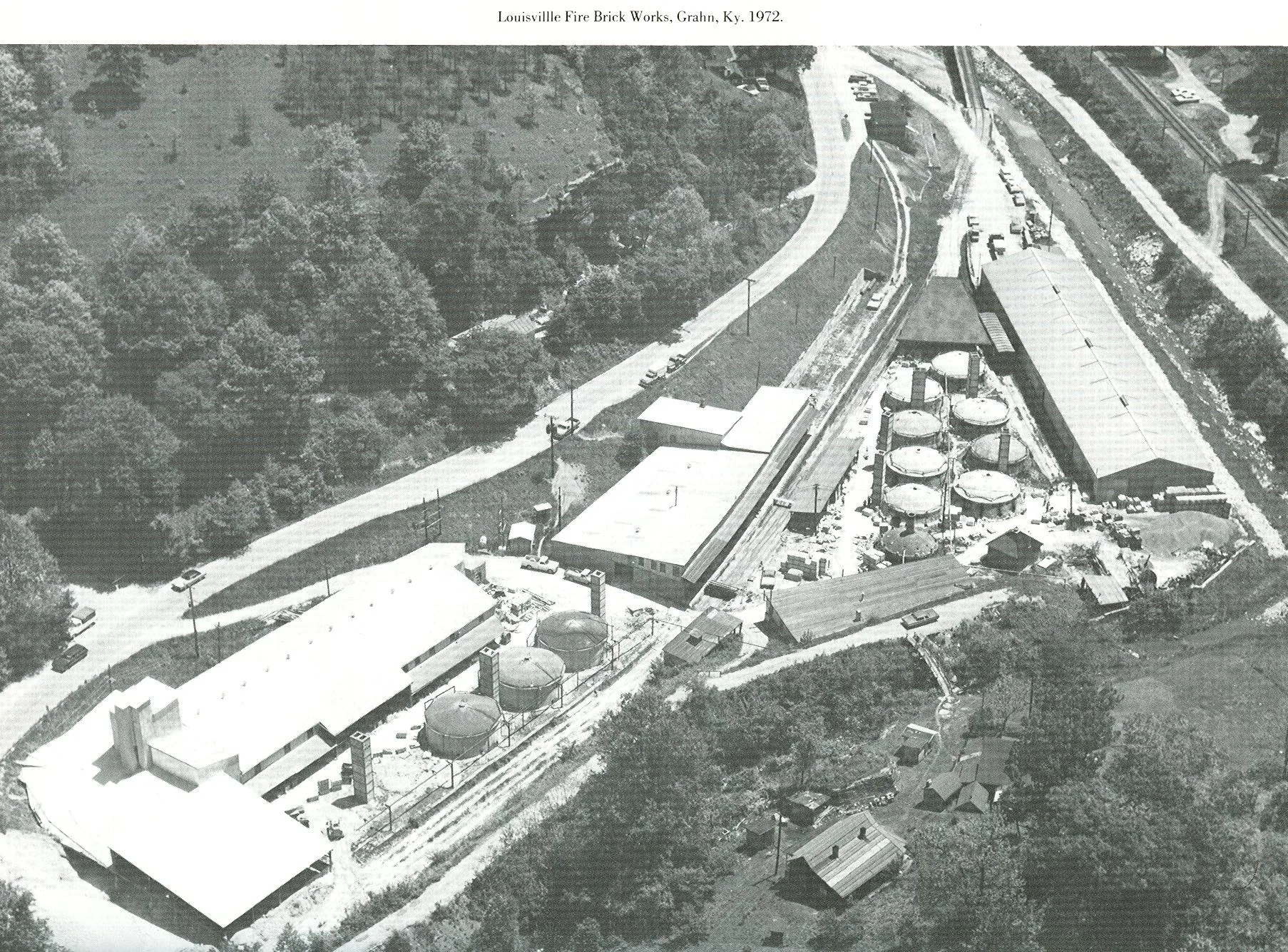
By far the line's most important twentieth-century industry was fire brick, made from a remarkable bed of fire clay that ran through the hills between Olive Hill and Morehead. The Ashland Fire Brick Company (later part of North American Refractories) built the first plant in the district at Ashland in the 1890s and a second at Hayward, six miles west of Olive Hill, in 1900; the Harbison-Walker Refractories Company of Pittsburgh completed its own plant at Olive Hill in 1901; the Kentucky Fire Brick Company, owned by Illinois Steel, opened at Haldeman in 1903; and by 1913 the Louisville Fire Brick Works at Grahn and the General Refractories plant at Hitchins had joined them. In all, eight plants operated within the fire-clay district itself, with three more outside it relying on Olive Hill clay exclusively — a combined capacity, by the early 1930s, of more than 500,000 nine-inch brick per day, or roughly fifty carloads. (C&O Magazine, Feb. 1932)
The clay that fed these plants came from company-owned mines along Perry's Branch near Olive Hill and from farms such as William Saulsberry's at Aden; a mine opened there in 1907 proved a solid bed of fire clay twenty-seven feet thick, and brick made from it took first place at the 1907 Jamestown Exposition. The finished product — sold under trade names like Ashland, Ashland Crown, and Tiger Steel — went out by rail to steel mills, blast furnaces, cement plants, and locomotive builders across the United States and as far afield as Canada, Japan, and Cuba, and lined the firebox of many a steam locomotive, C&O's own included. (Boy 1932; Salyers 2012)
The industry declined sharply after the Second World War, as steel mills shifted to basic oxygen furnaces that needed less refractory brick and the railroads that had been Olive Hill's other steady customer converted to diesel power. Plants closed one by one through the 1950s, '60s, and '70s, and the resulting loss of work sent a generation of Carter County families north to Ohio's industrial cities in search of factory jobs — an Appalachian migration as consequential, in its way, as the railroad itself had once been. (Richland County History)
Timber and Clay on the Morehead & North Fork
At Morehead the C&O connected with the Morehead & North Fork Railroad (M&NF), a twenty-four-mile short line running south to Redwine in Morgan County that gave the Lexington Subdivision access to yet another resource-based economy. Incorporated in 1905 and completed to Redwine in 1908, the M&NF was built to move hardwood logs for the Clearfield Lumber Company; two daily log trains, a merchandise train, and occasional coal trains kept as many as thirteen small steam locomotives busy in its best years, along with two daily passenger round trips and, after 1926, a gasoline motor car nicknamed the “Blue Goose.” (Wikipedia, “Morehead and North Fork Railroad”)
Local timber ran out by the early 1920s and Clearfield Lumber closed in 1922, but the railroad found a second life in 1925 when the Lee Clay Products Company opened a refractory-brick plant on the old mill site at Clearfield, drawing clay from mines at Clack Mountain over the same rails. The southern twenty-one miles of the line, no longer needed, came up in 1933, leaving only about four miles between the C&O connection at Morehead and the Clack Mountain mines. Lee Clay closed in 1970; a successor operation making lumber on the old brick-plant site kept a few miles of track alive until a kiln fire in April 1982 ended the last freight prospects, and the isolated remnant — stranded since the C&O itself was lifted through Morehead in 1985 — was finally removed in 2001. (Wikipedia, “Morehead and North Fork Railroad”; Rowan County History)
Steel at Coalton
The most durable industry on the line, as it turned out, was one of the newest. In 1963 the Mansbach family of Ashland, already in the scrap-metal business, incorporated Kentucky Electric Steel and built a minimill on the old AC&I ground at Coalton, melting scrap in an electric arc furnace rather than smelting ore the way the district's nineteenth-century iron furnaces once had. Production began in 1965. The mill weathered a 1985 shutdown and change of ownership, and continued making specialty steel bar flats for truck and trailer manufacturers for the rest of the twentieth century and into the twenty-first; Steel Dynamics acquired the operation in 2018, and it remains, as noted in Chapter 16, the sole regular customer on the surviving stub of the Lexington Subdivision today. (Encyclopedia.com, “Kentucky Electric Steel”)
The Bluegrass Trade
West of Mt. Sterling the line's freight character changed entirely, trading coal, clay, and timber for the produce of the Bluegrass Plateau: livestock, grain, tobacco, and the barreled whiskey of the region's distilleries, along with limestone quarried from the plateau's characteristic outcrops. None of it moved in the volume the coalfields or the brick district generated, but it gave the western end of the line a steadier, less boom-and-bust traffic base than the resource economies further east — fitting for a railroad that, as Chapter 10 describes, carried the Kentucky Derby crowds and the region's horse-farm visitors on its passenger trains for the better part of a century. (McChord 1976)
Steam on the Lexington Division
In the two decades before dieselization reached the line in February 1952, the Ashland-Louisville run carried some of the finest steam passenger power the C&O owned. The class J-2 Mountain type (4-8-2), a U.S. Railroad Administration design dating to 1918–19, and the ex-Richmond, Fredericksburg & Potomac F-20 Pacific (4-6-2), acquired secondhand and rebuilt at C&O's own Huntington Shops, both saw regular service on the George Washington and the F.F.V. between Ashland and Lexington. Earlier still, the class J-1 Mountain — the very first 4-8-2 ever built, in 1911 — and the smaller F-15 and F-16 Pacifics had held down the same trains. (Huddleston 1998)
Three factors governed which locomotives could run on the line: weight and clearance limits west of Lexington, where C&O used L&N track into Louisville; the Corey Hill grade profile detailed in Chapter 3; and a long-standing policy of assigning “hand-me-down” mountain-territory power once it had been bumped from more prestigious main-line assignments. The class J-3 Greenbrier 4-8-4 Northerns, C&O's most modern and powerful passenger design, were never assigned to the Lexington Division at all. And the 85-foot turntable at the shared C&O/New York Central engine terminal on the Louisville riverfront, mentioned in Chapter 3, kept the longest Mountains turning on a nearby wye instead. (Huddleston 1998)
Freight power told much the same story: 2-8-2 Mikados handled all freight until the arrival of the 2-8-4 Kanawha (Berkshire) type, which raised Corey Hill's tonnage rating from 1,650 tons to 1,850. (McChord 1976)
By 1948, with an oversupply of heavy Pacifics on hand — following the conversion of C&O's F-19 Pacifics into L-2 Hudsons for a streamliner project that never fully materialized — and passenger consists growing shorter, C&O finally assigned secondhand RF&P heavy Pacifics, reclassed F-20, to the lighter F.F.V., while the heavier, more powerful K-4 Kanawha 2-8-4, equipped with steam heat lines for passenger duty, took over the George Washington's Ashland-Lexington leg. The pairing gave the Lexington Division, for its last years of steam operation, some of the best-maintained and best-equipped passenger power on the entire C&O system — an unusual distinction for what was, on paper, a secondary line through some of the least accessible country in Kentucky. (Huddleston 1998)
The George Washington and the F.F.V.
When the C&O finally reached Louisville in 1881, its passenger business was oriented toward that city rather than Cincinnati — an arrangement that lasted until 1889, when the completion of C&O's own Cincinnati Division shifted the railroad's main passenger emphasis north. From then on, most C&O main-line trains carried a “Kentucky Section” that was split off at Huntington, and later at Ashland, to run the Lexington Subdivision into Louisville, much as a Charlottesville-Newport News section ran in Virginia — each a onetime main line reduced to secondary status by more important connections, but each still carrying its own share of local traffic. (Dixon 1976)
The Louisville line carried its own character: the Bluegrass region of horse farms, bourbon distilleries, and “Colonel” titles, with the Kentucky Derby drawing crowds each spring. C&O at one point ran eight trains daily in and out of Lexington's Union Station; by the 1950s only the eastbound and westbound sections of the George Washington remained. (McChord 1976)
Perhaps the most unusual passenger the line ever carried was the United States Declaration of Independence. At the outbreak of World War II, fearing the bombing of Washington, the government sealed the Declaration in a Pullman car and shipped it secretly over the C&O to Louisville and on to the gold depository at Fort Knox for safekeeping for the duration of the war. (McChord 1976)
Passenger service ended for good on May 1, 1971, when Amtrak's creation eliminated Trains 21 and 22 — the last of the George Washington's Kentucky sections. (McChord 1976)
Corey Hill and the Pushers
No feature of the Lexington Subdivision loomed larger in the memories of the men who worked it than Corey Hill, whose grade and helper operation are described in Chapter 3. Aden, on the west side of the grade, was not really a town at all but an operating point — the place where westbound freights picked up their pusher for the climb, surrounded by the caverns, sinkholes, and box canyons typical of the limestone country of the Appalachian Plateau. (Flash Flood at Aden)
One June morning in 1961, a young extra-board brakeman — eager, by his own account, for whatever work he could get — accepted an early call to Aden to help clean up a derailment, a day memorable enough that he wrote it up decades later for the C&O Historical Society's magazine. Stories like his, and the routine grind of pusher crews cutting off helpers “on the fly” at the summit, defined life on the Lexington Subdivision for the operating employees who worked it far more than the passing glamour of the George Washington ever did. (Flash Flood at Aden)
The People of the Railroad
Behind the timetables and locomotive rosters were the men who actually ran the trains, and a handful of their stories survive in print.
Captain Otho McFarland
Otho McFarland was born at Richmond, Kentucky, on May 9, 1876, and spent his career as a C&O conductor, eventually adopting the honorary title “Captain” — a nineteenth-century convention by which a conductor in charge of his train was addressed much as a ship's officer would be. On July 31, 1952, at Ashland, McFarland gave the highball for Denton, Kentucky for the last time before retiring; looking on from the cab doorway was Assistant Conductor R. E. Long, then in his thirty-fourth year with the C&O. (Bogart, McFarland)
Max M. Harnett
Max Malloy Harnett was born in Lexington, Kentucky in 1899 and went to work for the C&O in 1917, at age seventeen, in a transfer gang at the Netherland Yard in Lexington — transferring freight from boxcars too large to pass through the tunnels east of Lexington into smaller cars for the trip east. He later left briefly for other trades before returning to railroading, ultimately spending forty-eight years with the C&O and becoming a founding member of the Bluegrass Railroad Club and the Bluegrass Railroad Museum. (Bogart, Harnett 2005)
Wrecks, Floods, and Hard Days
The limestone hill country the Lexington Subdivision crossed was prone to flash flooding, and the line's operating logs and old-timers' memories were full of washouts and emergency callouts. One remembered incident at Leon, Kentucky recounted a family watching anxiously through a long winter for a replacement bridge to arrive by rail after a flood had taken out the original span, during the First World War era — work that continued through the winter until the new bridge was finally set in place in early 1918. (RR Stories, Leon)
An 1881 newspaper account from the Ashland Independent, written by an unnamed reporter who rode an Ashland Coal & Iron coal train to Rush Station hoping to connect with an EL&BS train beyond the Means tunnel, captured the improvisational nature of travel on the still-unfinished line — a stretch of muddy road between the mining village of Geigersville and Mount Savage Furnace forced the reporter to hire a horse from a schoolboy in order to complete the journey by land. (Ashland Independent 1881)
The Gulfco Wreck, 1935
The line's own operating records preserve at least one more fatal wreck besides the Winchester collision recounted below. On May 29, 1935, westward freight Train 73 derailed at Gulfco, Ky., a flag stop near Coalton on the old AC&I end of the line described in Chapter 7. The train — a K-3a Mikado, No. 2313, with twenty-eight cars and a caboose — came apart badly enough that both the engineer and the lead brakeman were killed. Surviving photographs from the scene, evidently taken for the railroad's own accident investigation, show the wrecked equipment scattered along the right-of-way, a grim counterpart to the more celebratory photography that otherwise fills the surviving record. (C&O Historical Society Photo Collection, cohs-80022 through cohs-80029)
A Fatal Wreck Near Winchester, 1906
Not every casualty of the Lexington Subdivision came from flood or fire. On December 4, 1906, a westbound through freight collided head-on with an eastbound local near Winchester, after wrong orders had been given by operators at Winchester or nearby Preston and both engineers believed they held a clear track. It was not yet light enough for either crew to see the other train until it was too close to avoid the collision. Both engineers and one fireman jumped and survived, though badly injured; a second fireman, nineteen-year-old George C. Sheehan of Owingsville, was caught between the engine and tender when the locomotives came together and killed instantly. Sheehan, who had gone to Lexington the previous January hoping to become a railroad engineer, had only recently hired on as a freight fireman on the run between Louisville and Ashland. His great-nephew, Everett N. Young, preserved the account from a 1906 clipping of the Owingsville Outlook kept by the family for sixty years, along with a shaving mug, painted with a 4-4-0 American locomotive, that had belonged to Sheehan. (Huddleston, Sept. 1976)
The Bluegrass by Rail: Travelers' Accounts
Few descriptions of the Lexington Subdivision capture its character better than the one Kentucky author Jesse Stuart wrote for the C&O's employee magazine TRACKS in August 1955. Stuart, a native of nearby Greenup, boarded Train 21 — a section of the George Washington — at Ashland with his wife Naomi, bound for Louisville on a family travel-plan ticket that cost the couple $19.48 round trip. (Stuart 1955)
“One can travel anywhere in America and in any country in Europe and not find a place like the East Kentucky hill country. Our long train curved in and out. The men who surveyed this line followed the path of least resistance. Often we looked out to watch the engine and then back at the last car. This was my country, where the hills were not high enough to be called mountains and too high to be called hills.” (Stuart 1955)
Stuart proposed his own name for the country the line traversed — “Cliff Country” — noting the rock ledges, mountain laurel, rhododendron, and tall firs that lined the right-of-way through Leon and Aden, and suggesting that if the same landscape lay in England, tourists would come by the trainload to see it. (Stuart 1955)
Decline and Abandonment
The Lexington Subdivision's decline traces cleanly through the pages of railroad and local newspapers — and, for its final years, through other published sources as well. Passenger service had already ended in 1971, as noted in Chapter 10. The abandonment that followed came in stages, working from the Lexington end of the line back toward Ashland. The C&O first posted notice in 1978 to abandon the ten miles between Chilesburg and Winchester, formally ended through service between Lexington and Winchester in April 1981, and pulled up seven and a half miles of track that autumn. The short remaining stub from Lexington to Chilesburg survived only to serve a fertilizer plant; when that business closed in 1983, those rails came up as well. In the interval, the Bluegrass Railroad Museum floated a $1.5 million plan, announced in July 1982, to buy the Chilesburg–Winchester segment and run a tourist railroad over it — a scheme that never came to fruition. (Abandoned Online)
Only after these western segments were gone did Chessie System move against the remaining Winchester-to-Coalton mileage. Freight traffic on that stretch had eroded steadily through the 1970s and early 1980s as Interstate 64, completed through the same corridor in the 1960s, drew business onto trucks. By 1983, rail traffic originating or terminating on the line had fallen more than 98 percent from its 1974 level — from 17,087 carloads to just 324. (Little Hope 1985)
On September 28, 1984, Chessie System (the C&O's parent) filed with the Interstate Commerce Commission to abandon 92.94 miles of the Lexington Subdivision between milepost 531.29 near Coalton and milepost 624.23 near Winchester — a move that would leave Olive Hill, Morehead, and Mt. Sterling without rail service for the first time in over a century. A Chessie spokesman noted that the line generated only about four carloads per mile per year, when fifty to a hundred were needed to break even. (Chessie Seeks to Abandon 1984)
The abandonment filing did not go entirely unanswered by dreamers. In February 1984, months before Chessie's application reached the ICC, the Kentucky House of Representatives' Committee on State Government approved a resolution putting a rather different idea on record: a state-operated, coal-fired steam tourist railroad running the old route between Ashland and Louisville by way of Olive Hill, Morehead, and Frankfort. State Representative Charles R. Holbrook III of Ashland, who sponsored the measure, argued it would draw tourists, provide jobs, create a market for Kentucky coal, and fill a transportation gap as Greyhound trimmed its bus routes through the region; he estimated the state could equip and operate such a line for under $10 million. The resolution created a task force to study the idea and report back by July 1985 — by which time, as it turned out, the railroad itself would already be gone. (Louisville Courier-Journal, Feb. 2, 1984)
A citizens' committee, organized under the FIVCO Area Development District, tried to find a buyer or lessee for the line, and TransKentucky Railroad Company — a Lexington-based shortline that had successfully taken over a similar money-losing L&N branch between Paris and Maysville — offered to lease the Winchester-to-Mt. Sterling segment for a token one dollar a year to try to build up traffic. Chessie declined the offer, preferring, in a spokesman's words, to relocate its resources. The ICC approved the abandonment on March 19, 1985, finding no evidence the line could be made profitable and noting that other shippers were effectively subsidizing its losses. (Little Hope 1985)
The numbers behind that finding were stark. Chessie's uncontested figures showed system-wide avoidable losses of $490,687 in 1983; losses attributable to purely local traffic ran even higher, at $779,964, offset only by the roughly 90 percent of the line's remaining tonnage that was overhead freight simply passing through rather than originating or terminating along the route. Twenty-three individuals and organizations filed protests or comments, but, the ICC noted, none submitted verified data to challenge Chessie's figures. One commissioner, Paul H. Lamboley, dissented in part, arguing the line should be allowed to close only as far as Ewington, sparing the final 17.99 miles into Winchester in order to protect a $326,000 federally funded rail spur recently built to serve the Midland Trail Industrial Park at Mt. Sterling — a spur that, in the majority's ruling, became useless the moment the line above it closed. (Little Hope 1985)
The fire-brick industry described in Chapter 8, already a shadow of its early-century self, absorbed the abandonment with the resignation of a business that had largely moved on already. Nick Desantis, plant manager at General Refractories in Hitchins, said the closure meant trucking his products some fifteen miles to a makeshift wharf near Coalton for reloading onto rail cars, but allowed that the plant was shipping only eight to ten carloads a year by then and would feel the loss less than others might. At Louisville Fire-Brick's thirty-three-worker plant in Grahn, manager Mike Cartee made much the same point from the other direction: the plant sat directly alongside the main line but had not shipped anything by rail in roughly two years, having already shifted entirely to trucks — his worry was less about his own operation than about competitors who might keep a rail-served edge a little longer than he did. (Little Hope 1985)
Chessie abandoned the Coalton-to-Winchester segment on or about May 13, 1985. The affected workforce was small: a track foreman, three trackmen, and a signal maintainer at Mt. Sterling, an agent-operator at Olive Hill, and the five-man crew of the line's remaining trains, Nos. 391 and 392. By then those trains ran only three days a week, called at Russell around 5:30 a.m. on Mondays, Wednesdays, and Fridays for an afternoon arrival at the Seaboard System's Patio Yard in Winchester, with No. 392 returning east once the crew had rested. Consists ran five to twenty-five cars, heavily weighted toward gondolas, behind a pair of four-axle diesels, and both trains did most of their actual work switching cars at Kentucky Electric Steel in Coalton — the same customer, described in Chapter 8, that would go on to be the line's sole survivor. (Chessie Bids Bye-Bye 1985)
The following year, in June 1986, Addington Inc. purchased 2.48 miles of the abandoned right-of-way in Boyd and Carter counties for $300,000 — 15.6 acres in Boyd County and roughly 12.75 acres in Carter County, according to the deed — intending to build a coal-loading facility adjoining a 22,000-acre coal tract the company already owned and was mining across Boyd, Greenup, and Carter counties. Until the facility was built, an Ashland attorney representing the firm noted, the coal would keep moving out by truck to river loading points, just as it already was; the old rail corridor promised only to make that same coal cheaper to ship, not to reopen the line itself. It was one of several small parcels of the old right-of-way sold off for scrap value or redevelopment once the rails came up. (Remnant of Lexington Sub Sold 1986)
What Remains
Only a short stub of the original Lexington Subdivision remains in service today, running from Ashland to Coalton, where it continues to serve local industry — the same territory once worked by the old Ashland Coal & Iron Railroad described in Chapter 7. As of the most recent published account located, the stub's sole customer is the successor to Kentucky Electric Steel, operating today as Steel Dynamics' Steel of West Virginia division — the same corridor, worked continuously in one form or another since the Ashland Coal & Iron Railway first laid rail there in the 1850s. (Abandoned Online)
The Big Run Landfill
For a decade and a half, that surviving stub carried an entirely different kind of traffic. Construction of the Big Run Landfill in Boyd County proceeded from 2001 to 2004, and a three-track yard was added at Coalton in 2005 to handle the taller, heavier cars needed to haul waste in by rail; CSX later enlarged the Ashland and Princess tunnels to accommodate this equipment, completing clearance work at Princess in 2013. The landfill's permitted capacity grew from an original 7,000 tons over its lifetime to as much as 43 million tons, the great majority of it hauled in from outside Kentucky — principally New York and New Jersey. By 2013, Big Run had grown into Kentucky's largest landfill and one of the largest in the nation, accepting more than 3,500 tons of waste daily, some 90 percent of it from out of state. (Abandoned Online)
That growth came at a cost to the surrounding community. A landslide in September 2013 involving more than 800,000 tons of waste damaged the landfill's methane collection system, and residents of nearby Princess and Cannonsburg reported odors strong enough to reach a local high school and to be detected up to ten miles away. Kentucky's Energy and Environment Cabinet cited the operator, EnviroSolutions, for permit violations dating to 2009 and fined the company $275,000 in January 2014. Class-action litigation followed in 2015, and the Boyd County Fiscal Court voted that summer to call for the landfill's rail operations to end. (Bruggers 2015; WSAZ 2015)
EnviroSolutions agreed to phase out rail deliveries of out-of-state waste under a negotiated settlement, and moved up its own deadline: the last trainload of trash reached Big Run on April 19, 2016, roughly two months ahead of the agreed June 30 cutoff. The shutdown cost the company an estimated forty to fifty landfill jobs and about nine rail positions based at Russell, and the landfill's rail yard — by then the only regular traffic the line carried besides the steel mill at Coalton — was dismantled shortly afterward. The landfill itself continued operating on local waste only, and freight on the surviving stub returned to the steel traffic that had sustained it for most of a century. (Herald-Dispatch 2016; Waste Dive 2016)
The Rail Trail
Efforts to convert the abandoned right-of-way into a recreational trail have moved slowly. A proposed 109-mile Lexington-Big Sandy Rail Trail, identified in the Kentucky Transportation Cabinet's 2002 Statewide Rail Plan, stalled when a legislative task force assigned to study the project failed to convene before its December 2002 deadline. As of the mid-2000s only about thirty of the corridor's miles were even in public ownership, held by CSX Transportation, with the remainder in private hands. (Inaction Halts Rail Trail 2003)
The Mt. Sterling depot was restored beginning around 2006 through a local high school preservation project, and a handful of other depots and structures survive here and there along the old grade — visible reminders, along with the cuts and abandoned tunnel portals still overgrown with brush, of a railroad that carried the C&O's finest passenger trains through the heart of the Bluegrass for the better part of a century. (Mt. Sterling Depot 2008)